Last Updated on April 4, 2026
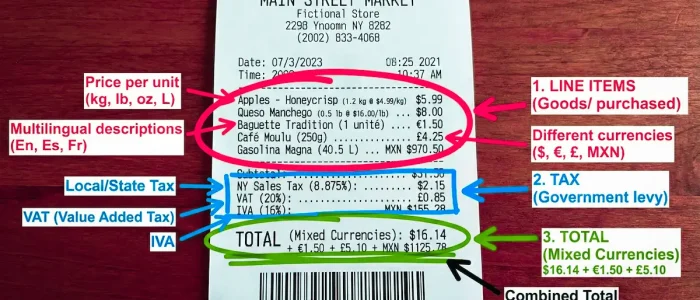
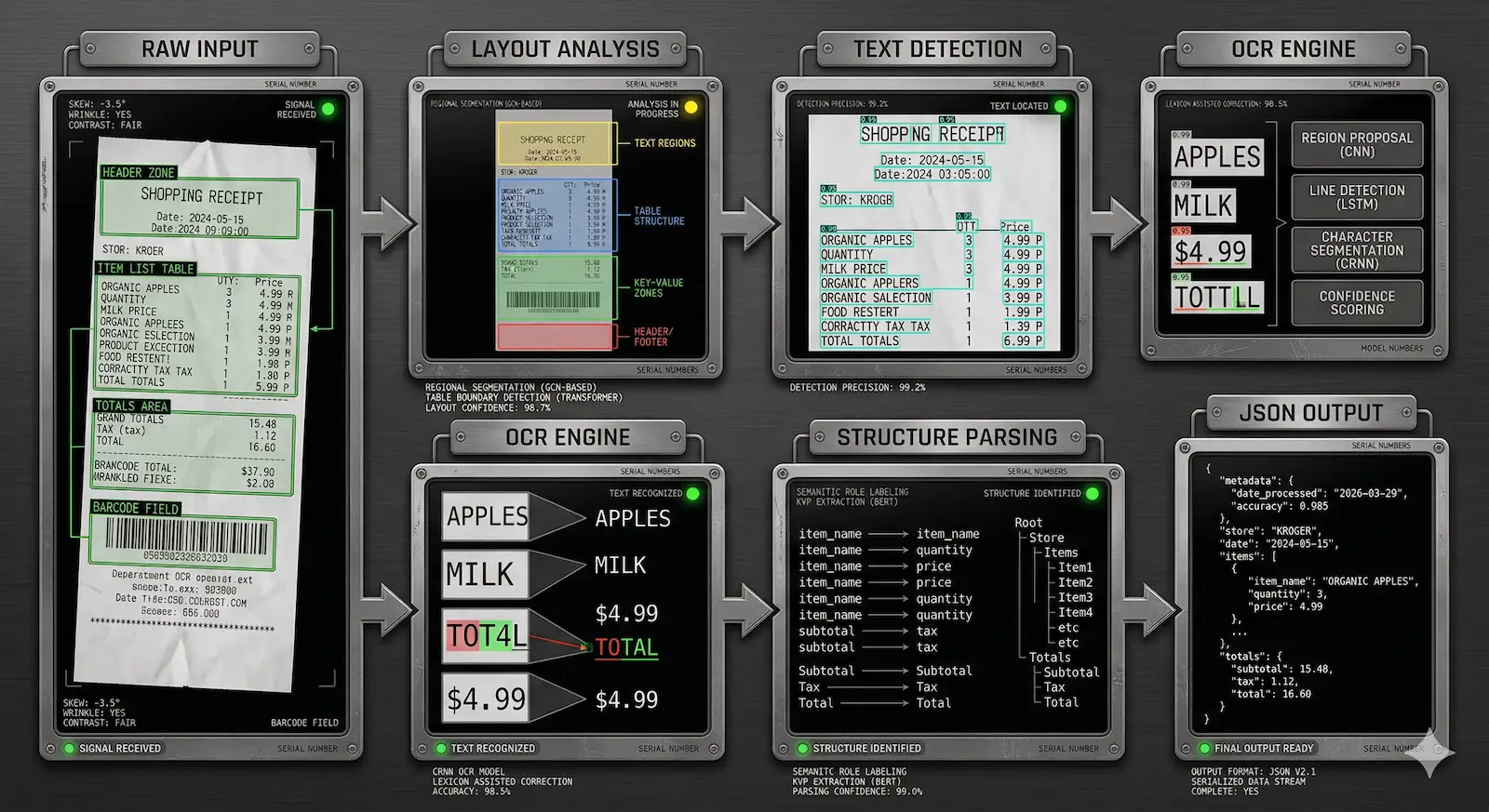
A layout aware pipeline is a multi-stage AI architecture that interprets the spatial structure of a document before extracting data from it. Unlike standard OCR, which reads text linearly, it classifies fields by visual position. Recognizing that “Total” belongs at the bottom right regardless of the merchant’s template or POS system.
How a Layout Aware Pipeline Differs from Standard OCR
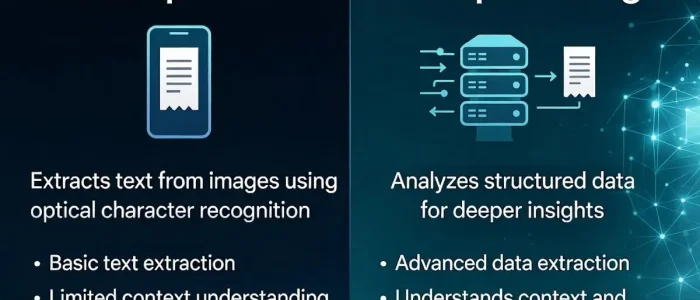
Standard OCR converts pixels to text. A layout aware pipeline adds document intelligence. It understands relationships between fields, handles skewed or crumpled receipts, and identifies line items across irregular columns. This structural layer is what makes receipt understanding OCR reliable at the transaction volumes enterprise clients require. It handles structural anomalies, skewed images, and irregular columns.
Consider a faded, crumpled restaurant receipt with a tip written in pen. Standard OCR might jumble the printed subtotal with the handwritten tip. A layout-aware system understands the visual hierarchy, isolating the line items, separating the tax, and correctly identifying the final total based on its spatial context.
Pre-Processing: The Foundation of Accurate Receipt Data
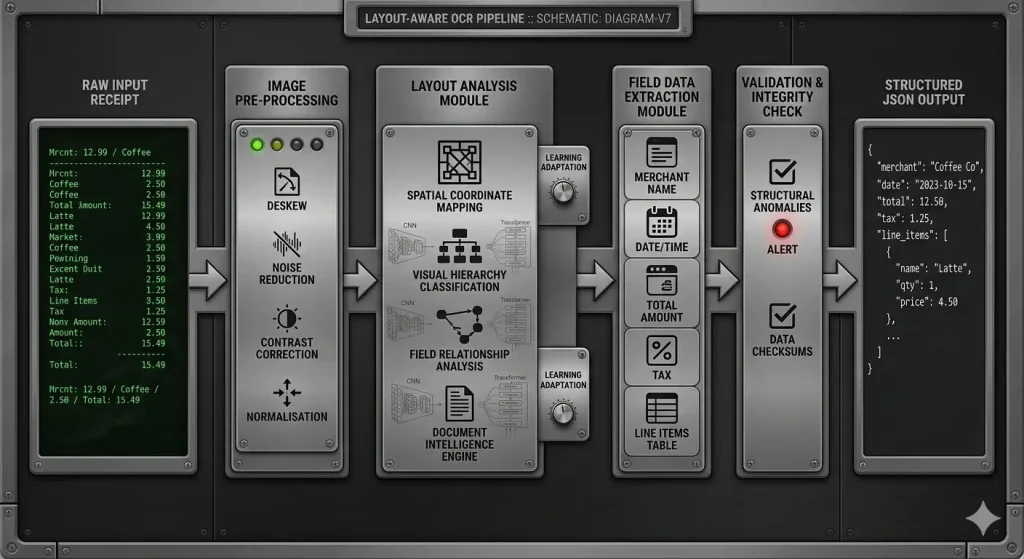
Before layout analysis begins, Tabscanner’s pre-processing stage performs image normalisation, deskewing, noise reduction, and contrast correction. These steps are critical for receipts captured by smartphone cameras in variable lighting conditions. Clean input at this stage directly determines downstream extraction accuracy across millions of daily API transactions.
Field Classification and Semantic Understanding
The pipeline classifies fields — Merchant, Date, Tax, Total, Line Items — using spatial coordinates and visual hierarchy rather than keyword matching. This means Tabscanner correctly identifies a figure at the bottom right as “Total” and one at the top as “Store Number,” adapting automatically to thousands of POS layouts without manual template configuration.
Instant Learning and New Format Adaptation
Tabscanner’s model applies instant learning to adapt to new or updated POS receipt formats without full retraining cycles. When a retailer updates their receipt design, the system recognises structural patterns from previously seen analogues — reducing onboarding time for new enterprise clients and sustaining accuracy across diverse global retail formats.
Fraud Intelligence and Data Integrity
A layout aware pipeline supports fraud intelligence by detecting structural anomalies — receipts where spatial relationships between fields are inconsistent with known POS templates. Tabscanner flags suspect patterns at the extraction stage, giving enterprise clients in loyalty programmes, expense management, and insurance a first line of defence against manipulated receipt submissions.
Document Intelligence at Enterprise Scale
Tabscanner’s document intelligence capabilities extend beyond receipt parsing. The same layout aware architecture processes invoices, fuel receipts, and pharmacy documents — providing a unified extraction layer for enterprise clients handling high volumes of diverse document types across multiple markets, geographies, and languages.
Technology Stack
Tabscanner’s layout aware pipeline is built on TensorFlow and Keras for model training and neural network layers, with Redis managing caching for high-volume API throughput. The three-stage process: pre-processing, layout analysis via CNNs and Transformers, and structured JSON output — delivers up to 99.99% accuracy across thousands of global retail formats.

Based in Tokyo, Ben Smith is the Chief Technology Officer and Head of Research at Tabscanner. He pioneers deep learning models specifically designed for receipt optical character recognition (OCR) and document classification, engineering the core AI architectures that enable high-accuracy data extraction.